Tarmac vs block paving: what Irish homeowners need to know
Comparing tarmac and block paving for Irish driveways — cost, durability, maintenance, drainage and which one makes sense for your property.
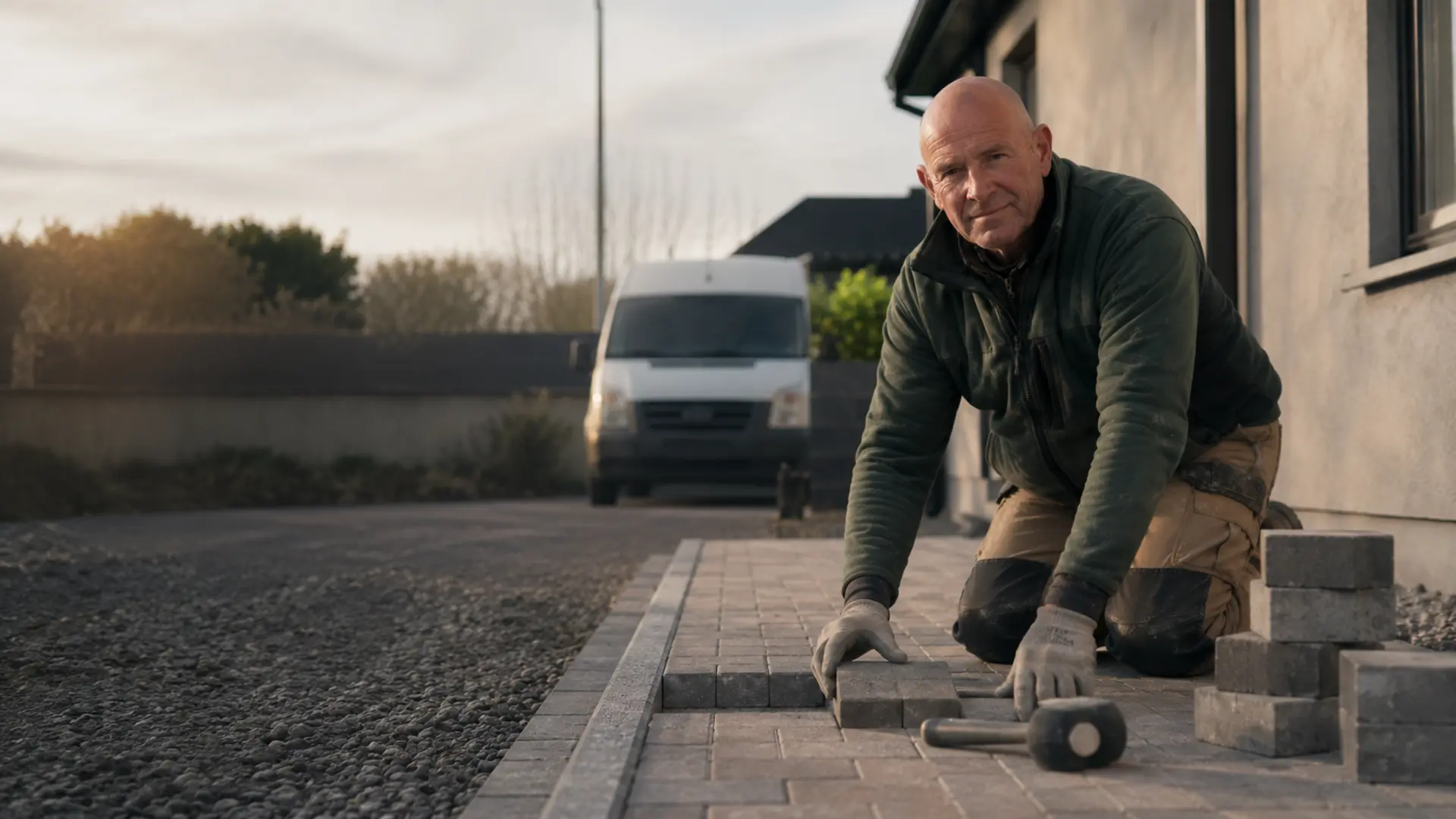
Most homeowners replacing a driveway in Ireland narrow it down to two options: tarmac or block paving. They’re the two most common choices for good reason — both are durable, both handle Irish weather well, and both are widely available from contractors across the country. But they’re very different products, and the right one depends on what you actually care about.
Here’s an honest comparison.
Cost
Tarmac wins on price, and it’s not close.
A standard single-car tarmac driveway in Ireland costs between €2,500 and €3,500. Block paving for the same space typically runs €4,000 to €6,000, with quality natural stone going higher.
The gap is mainly labour. Tarmac is poured and rolled; the job is done in a day or two. Block paving is laid stone by stone, one at a time, with careful attention to levels, edging and jointing. It takes longer and charges accordingly.
If budget is your primary concern, tarmac is the clear choice.
Appearance
Block paving wins on looks, and most homeowners know it.
A well-laid block paved driveway — especially with natural stone or tumbled concrete blocks — adds genuine kerb appeal and a sense of finish that flat black tarmac simply doesn’t. You can choose colours, patterns and border details. It’s a material that ages gracefully when maintained.
Tarmac is functional and clean when new, but it’s a plain surface. It does the job without drawing attention to itself. That’s fine if you’re focused on practicality over aesthetics, but if you’re trying to improve the appearance of the front of your house, block paving is the better investment.
Durability
Both materials are durable if they’re installed correctly on a proper sub-base. That caveat matters: a tarmac driveway laid on poor ground will crack; block paving laid without adequate compaction will sink and shift. The material is only as good as the preparation underneath.
Tarmac typically lasts 15 to 20 years before it needs resurfacing. Block paving, properly maintained, can last 30 to 50 years. Individual blocks can be lifted and replaced if one area sinks or a utility company needs access — tarmac has to be dug up and patched, which rarely looks clean.
On a long enough timeline, block paving is the more durable and more serviceable option. Whether that justifies the extra upfront cost depends on how long you plan to stay in the property.
Maintenance
Tarmac is lower maintenance in the short term. Sweep it, clear the leaves, and it largely looks after itself. It can be resealed every few years to extend the life and brighten the colour, but that’s optional.
Block paving requires more attention. The joints need to be re-sanded with kiln-dried jointing sand every three to five years as the original fills wash out. Without that, weeds establish in the joints and the surface looks tired. You’ll also want to apply a sealer periodically to protect the colour and prevent staining — oil and rust marks show more clearly on block paving than on dark tarmac.
If you want the nicest-looking driveway with the least ongoing effort, tarmac is more honest about what it asks of you.
Drainage and planning
This is where block paving has gained a significant practical advantage in recent years.
Local authorities across Ireland are increasingly applying SUDS (sustainable urban drainage system) requirements to new and replacement driveways. The principle is that rainwater run-off from hard surfaces should drain into the ground rather than overloading the drains. Impermeable tarmac fails this test; it channels water straight to the drain.
Block paving, when laid with open joints filled with permeable jointing sand, allows water to filter through the joints into the sub-base and drain naturally. It satisfies SUDS requirements without any additional engineering.
If you’re replacing a driveway in an area where your local authority enforces SUDS, or if your planning permission makes it a condition, block paving is the compliant choice. Tarmac can still be used with a properly designed drainage channel or soakaway, but it adds cost and complexity.
Which one is right for you?
Here’s a simple way to think about it:
Choose tarmac if: you want a reliable, affordable driveway with minimal fuss; you’re planning to sell in the next few years and don’t want to over-invest; or you have a large area to cover and budget is the constraint.
Choose block paving if: you want to improve the appearance of the property and add kerb appeal; you’re staying for the long term and want a surface that lasts; or you’re in an area where SUDS compliance is required or likely to be.
Consider resin bound if: you want the aesthetic of block paving with even lower maintenance, and you’re happy to pay a premium for it. It’s worth reading about resin bound driveways in Ireland separately — it’s a different product with a different set of trade-offs.
Whatever material you choose, the contractor matters as much as the surface. A good job on either material will outlast a poor job on the other. Get three written quotes, check that your contractor is insured and CRO-registered, and ask to see a completed job before you commit.
If you need a vetted paving contractor in your county, Ranksy covers all 26 counties of Ireland with one verified contractor per area.